Delivery workflows
Explore the course guide, practise the ideas and discuss the work you want to build with your tutor.
PRACTICAL LEARNING. A CLEARER NEXT STEP.
Connect development work with the way software is delivered and maintained. Explore repeatable workflows, operational thinking and useful automation.
Develop foundations for software-delivery projects, technical collaboration and further DevOps learning.
Explore the course guide, practise the ideas and discuss the work you want to build with your tutor.
Explore the course guide, practise the ideas and discuss the work you want to build with your tutor.
Explore the course guide, practise the ideas and discuss the work you want to build with your tutor.
Bring your goals and questions. The course guide below explains the areas of learning; admissions can help you check the starting requirements, equipment and available format before you enrol.
Ask about suitability and requirements ↗Read the learning areas and existing curriculum. Current fees and durations are shown separately below.
Every application you use was built by developers. But the system that gets that application from a developer’s laptop to your screen – reliably, securely, and at speed – was built by a DevOps Engineer. Behind every software product that works, every deployment that does not break, every system that stays online when thousands of users hit it at once, there is a DevOps professional who designed and maintains the infrastructure of delivery.
Why DevOps Engineers Are Some of the Most Valuable People in Technology
The numbers behind this career path reflect how critical the discipline has become.
LinkedIn’s job data consistently shows DevOps as one of the top ten most searched technical roles on the platform. Startups need it. Banks need it. E-commerce platforms need it. Healthcare systems need it. Government digital services need it. The demand is not concentrated in one industry – it is everywhere software is being built, which means everywhere.
What DevOps Engineering Actually Is
Most people hear DevOps and think it is about servers or cloud platforms. That is only part of it.
DevOps is the practice of connecting software development – the act of writing code – with operations – the act of running that code reliably in production. Before DevOps, these were two separate teams that rarely communicated well. Developers wrote code and threw it over a wall to operations teams who struggled to deploy it without breaking things. Systems crashed. Deployments took weeks. Problems took days to detect.
DevOps tore that wall down. It replaced manual, slow, error-prone deployment processes with automated pipelines that test, build, and deploy code continuously. It replaced reactive problem detection with proactive monitoring systems that identify issues before users feel them. It replaced fragile, manually configured servers with infrastructure defined in code – version controlled, repeatable, and scalable.
A DevOps Engineer is the professional who builds and maintains all of that. They are the reason modern software companies can ship new features daily without breaking the product their users depend on.
What Mita School’s DevOps Programme Covers
This programme is built around seven months of progressive, hands-on learning that mirrors exactly how DevOps is practiced inside professional engineering teams today.
You begin with the foundations that every DevOps engineer must have – Linux administration, networking, and shell scripting. These are not optional extras. They are the ground on which everything else is built, and skipping them is why many self-taught DevOps practitioners have gaps that cost them in interviews and on the job.
From there you move into version control and collaborative development workflows using Git and GitHub – understanding how engineering teams manage code at scale and how DevOps integrates into that workflow from the beginning.
You then build deep competence in containerization using Docker and container orchestration using Kubernetes – the two technologies that have fundamentally changed how applications are packaged and deployed. You will not just learn what these tools do. You will use them to build and deploy real applications in real environments.
Infrastructure as Code follows – using Terraform to provision and manage cloud infrastructure the way professional teams do it, through code that is version controlled, repeatable, and auditable. You will work across AWS as the primary cloud platform with foundational exposure to Azure and GCP.
CI/CD pipeline engineering is where the programme goes deepest – because automated delivery pipelines are the core product of a DevOps engineer’s work. You will build pipelines using GitHub Actions and Jenkins that automatically test, build, containerize, and deploy applications on every code change. You will implement security scanning, quality gates, and deployment controls that protect production systems while enabling fast delivery.
Monitoring, observability, and incident response rounds out the technical curriculum – using Prometheus, Grafana, and the ELK Stack to build systems that detect problems before users do, alert the right people immediately, and give engineering teams the data they need to resolve incidents fast.
The final phase is a capstone project – a complete, production-style DevOps platform built and documented by each student, demonstrating every skill developed across the seven months.
Who This Programme Is Built For
This programme is designed for anyone who wants to work inside modern software engineering teams in a role that is technically challenging, highly compensated, and genuinely critical to how software gets built and delivered.
If you are a developer who wants to understand the full software delivery lifecycle and move into a higher-paying infrastructure and automation role, this programme accelerates that transition directly. Your development background is an advantage here – understanding code makes you a better DevOps engineer than someone who only knows operations.
If you are an IT professional – a network administrator, systems administrator, or technical support specialist – DevOps is one of the clearest and most financially rewarding specialization paths available to you. The infrastructure knowledge you already have gives you a foundation that many beginners spend months building.
What You Can Do With This Skill
The roles that open after this programme reflect the full range of where DevOps professionals work.
As a DevOps Engineer you join engineering teams at startups, scale-ups, and enterprises to own the delivery pipeline – building and maintaining the systems that get software to production. As a Site Reliability Engineer you apply engineering principles to operations work, defining and defending the reliability standards that keep systems running at the level users expect. As a Platform Engineer you build the internal developer infrastructure that enables software teams to deploy faster and more safely. As a Cloud Infrastructure Engineer you specialize in designing and managing the cloud environments that applications live in.
All of these roles are available remotely. The infrastructure that DevOps engineers manage lives in the cloud – which means the work can be done from anywhere with reliable internet. Nigerian DevOps engineers are working for companies in the United Kingdom, the United States, Canada, and across Europe right now, earning in foreign currency while living in Uyo.
The Mita School Approach to DevOps Engineering
Mita School does not teach tools. It builds engineers.
The DevOps programme is structured so that every concept is applied in a real environment before the next concept is introduced. You do not learn what a CI/CD pipeline is in theory and then move on. You build one, break it, fix it, and understand exactly what each component does and why it is there.
Instructors in this programme bring current industry experience – not textbook knowledge – into every session. The curriculum is built around how DevOps is actually practiced in engineering teams today, the tools those teams are actually using, and the problems those teams are actually trying to solve.
Certificate of completion from Mita School upon successful completion of the programme.
Enroll Now – The Pipeline Does Not Build Itself
Mita School’s DevOps Engineering Training in Uyo is enrolling now. Cohort sizes are strictly limited to ensure every student gets the individual attention this level of training demands.
If you are ready to build the infrastructure of modern software delivery – the pipelines, the platforms, the monitoring systems, and the automation that the industry cannot function without – this is where you begin.
Enrollment is open. Seats are limited. The industry is waiting.
Compare the current approved choices. Choose a mode to continue through the existing Mita School registration process.
₦500,000tuition
Pay tuition in full: ₦475,000
5% saving on tuition only.
40%, then 35%, rounded upward to ₦10,000 where applicable; the final payment is the exact tuition remainder. Your quote confirms due dates.
Intake begins 7 December 2026
Choose physical & register →₦600,000tuition
Pay tuition in full: ₦570,000
5% saving on tuition only.
40%, then 35%, rounded upward to ₦10,000 where applicable; the final payment is the exact tuition remainder. Your quote confirms due dates.
Intake begins 7 December 2026
Choose online & register →Already enrolled? Your agreed quote, payment dates and records remain unchanged. Use your existing student account.
Student login →These are school-wide published projects with their available creator details. They are examples of community work, not a promise of results from this course.
Add or remove VAT, check the tax breakdown, and calculate totals using a rate you choose.
By Godwin Lawson · View creator profile View case study

Speak with admissions if you need help choosing a course, learning mode or payment plan.
Many Mita School programmes welcome beginners. Review this course’s guide and ask admissions to confirm the starting requirements and equipment for your situation.
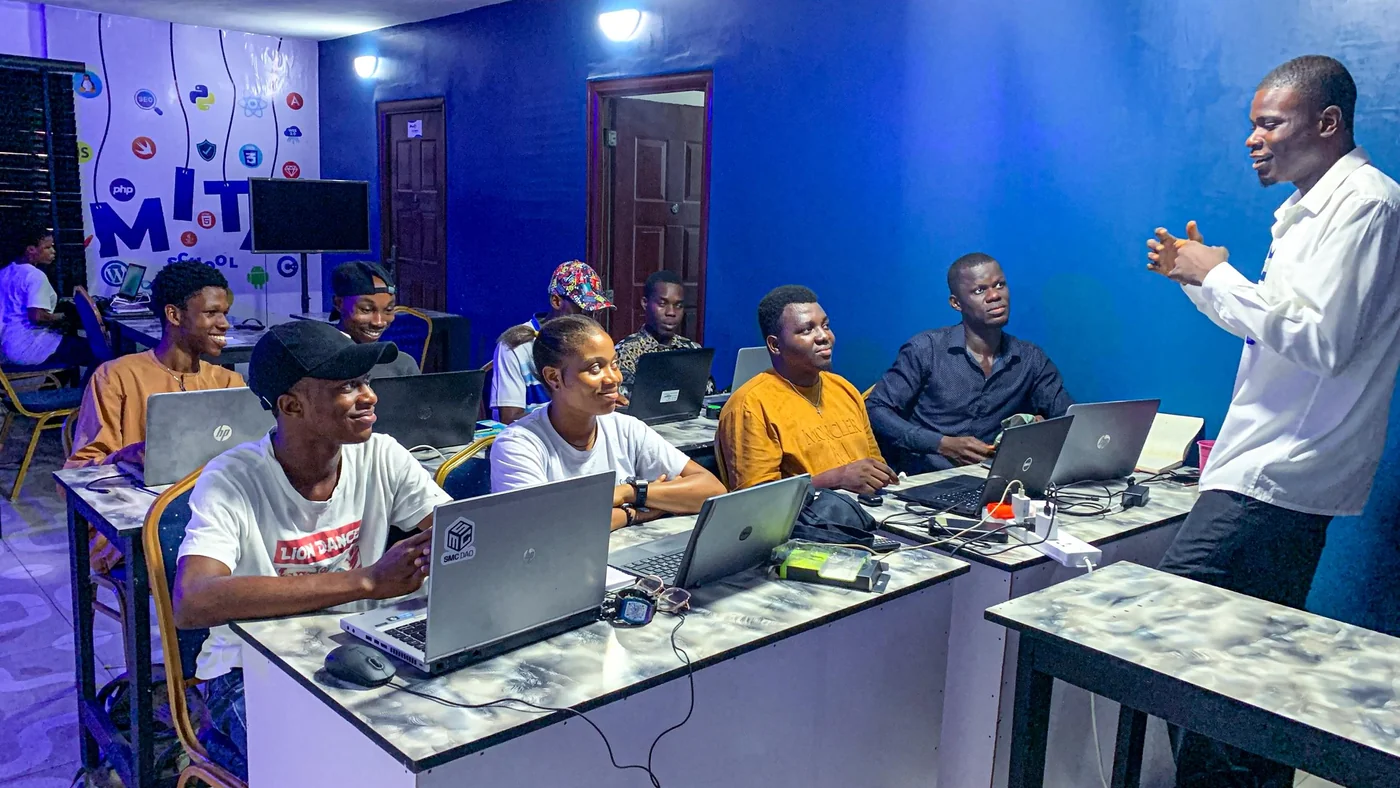
Mita School is at 15 Ekpenyong Street, Off Barracks Road, Uyo, Akwa Ibom State. You can visit to discuss your course, see the learning environment and ask questions before enrolling. Confirm the venue shown for your chosen intake before making travel arrangements.
The available choices are shown in this page’s fees section. Online programmes with an approved physical reference use physical tuition plus ₦100,000 and run one calendar month shorter. If a reference or programme mapping still needs confirmation, contact admissions for the current offer.
A full payment saves 5% on tuition only. Eligible installment plans use 40%, then 35%, rounded upward to ₦10,000 where applicable, followed by the exact tuition remainder. The ₦15,000 student ID card and branded T-shirt package is collected once where applicable with the first payment. A confirmed prior package payment is not charged again; no cap is included. Your quote shows the applicable combined amount before payment.
Certificate of completion from Mita School upon successful completion of the programme. External professional certification exams are separate; ask admissions about any confirmed exam inclusion and costs.
Choose an available learning mode above, enter your details, verify your email and review your quote before checkout. After server-verified successful payment and active enrollment, your student dashboard shows My enrolments. Check your email for confirmation and joining details. Keep your existing email/account if you are already a student.
Talk to Mita School about DevOps Engineering in Uyo, Akwa Ibom.