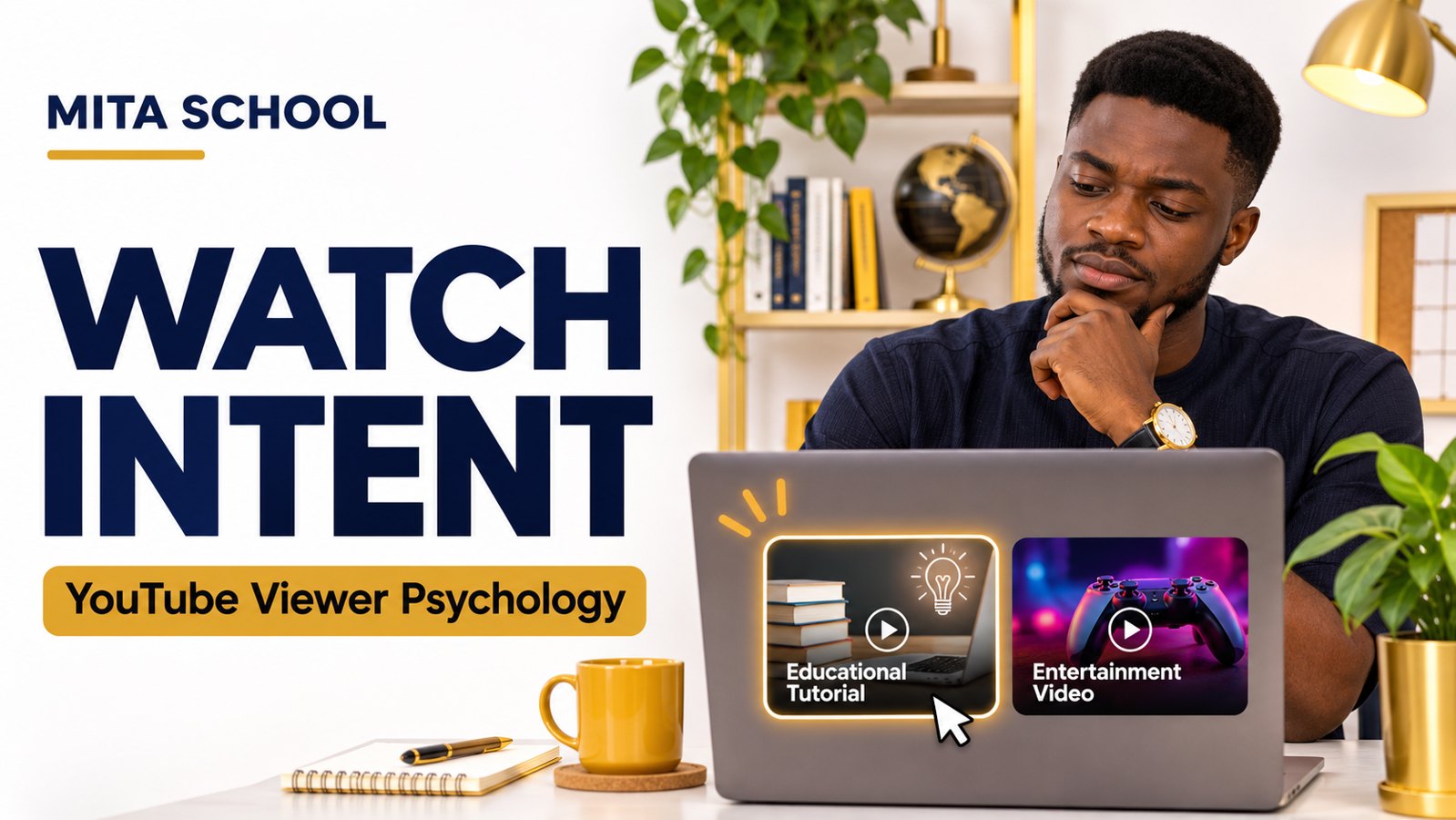

What Is the Difference Between Search Intent and Watch Intent?
Search intent explains why someone enters a query. Watch intent explains what the person expects to receive after choosing a video. Understanding both helps creators move beyond keywords and produce content that gets discovered, selected and watched.
Quick Answer: Search Intent vs Watch Intent
Search intent is the reason behind the words a viewer enters into YouTube Search. It explains what the person is trying to find, learn, solve, compare or locate.
Watch intent is the experience or outcome the viewer expects after selecting a video. It includes the desired depth, format, pace, emotion, duration and level of explanation.
A video may match the search phrase but fail the watch intent. For example, a title may correctly target “how to edit videos in CapCut,” but viewers may leave if it provides general advice instead of a practical demonstration.
A viewer opens YouTube and searches:
How to create an AI voiceover
The search phrase reveals that the person wants information about turning text into spoken audio.
However, it does not tell you everything.
The viewer may want:
- A free method.
- A Canva demonstration.
- A natural-sounding professional voice.
- A mobile-phone workflow.
- A Nigerian payment option.
- A two-minute answer.
- A complete beginner class.
The words reveal the general need. The preferred viewing experience remains partly hidden.
Search intent brings the viewer to the shelf. Watch intent determines which book they choose and whether they keep reading.
Lawson Godwin Hezekiah
What Is Search Intent on YouTube?
Search intent is the purpose behind a query entered into YouTube’s search box.
It helps explain what the viewer is trying to accomplish through the search.
Examples include:
- Learning how to complete a task.
- Finding a specific video or channel.
- Understanding a concept.
- Comparing products or tools.
- Investigating a problem.
- Following a current event.
- Finding entertainment around a preferred subject.
Search intent is expressed through words, although those words may be incomplete or ambiguous.
A query such as “CapCut voiceover” could mean:
- How to record a voiceover in CapCut.
- How to generate text-to-speech in CapCut.
- How to import an external voiceover.
- How to fix low voiceover volume.
- How to remove background noise.
The creator must identify the most likely problem or choose one specific interpretation.
What Is Watch Intent on YouTube?
Watch intent is the result, depth, format or emotional experience a viewer expects after choosing a video.
It begins before the click but continues throughout the viewing experience.
Watch intent can include:
- How quickly the viewer expects the answer.
- How detailed the explanation should be.
- Whether the viewer wants theory or demonstration.
- Whether the content should educate or entertain.
- Whether the viewer is a beginner or professional.
- Whether local context is necessary.
- Whether the viewer wants a summary or complete class.
A Simple Definition
Search intent answers: “Why did this person search?”
Watch intent answers: “What must the selected video provide for this person to feel satisfied?”
What Is the Main Difference Between Search Intent and Watch Intent?
The Discovery Objective
Search intent explains the purpose behind the viewer’s query and helps determine which videos appear relevant to the words entered.
It is closely connected with topic selection, keyword language, titles, descriptions and query relevance.
The Viewing Expectation
Watch intent explains what kind of experience will satisfy the viewer after discovery.
It is closely connected with format, duration, opening, structure, depth, pacing, examples, emotion and retention.
| Content Factor | Search Intent | Watch Intent |
|---|---|---|
| Main Question | What is the viewer trying to find? | What viewing experience will satisfy the viewer? |
| Primary Evidence | Queries, autocomplete suggestions and search terms. | Clicks, retention, watch time, comments and satisfaction. |
| Main Content Decision | Which topic and wording should be targeted? | How should the answer or experience be delivered? |
| Before the Click | Helps the video appear relevant to the query. | Influences which title, thumbnail and duration seem appropriate. |
| After the Click | The search query remains the starting context. | The video must fulfil the expected depth, pace and outcome. |
| Failure Example | The video targets the wrong query. | The query is correct, but the viewing experience disappoints. |
How Do Search Intent and Watch Intent Work Together?
Search intent and watch intent are not opposing concepts. They represent different stages of one viewer journey.
The Search
The viewer expresses a problem or interest through words.
The Selection
Titles, thumbnails, channels and durations are compared.
The Experience
The chosen video either fulfils or disappoints the watch intent.
A successful search-focused video usually performs well across all three stages.
It matches the query, appears capable of answering it and then delivers the expected result.
What Are the Main Types of Search Intent on YouTube?
1. Informational Intent
The viewer wants to understand a subject.
Example: What is YouTube audience retention?
2. How-to or Problem-Solving Intent
The viewer wants to complete a task or fix a problem.
Example: How to balance voiceover and music in CapCut.
3. Navigational Intent
The viewer wants to locate a particular creator, channel, song, speech or video.
Example: Mita School YouTube automation training.
4. Comparison Intent
The viewer wants to evaluate alternatives.
Example: ElevenLabs vs Canva text-to-speech.
5. Commercial Investigation Intent
The viewer is considering a purchase, subscription, course or service.
Example: Best YouTube automation course in Nigeria.
6. Entertainment Intent
The viewer wants content around a particular person, event, story, sport or emotional interest.
Example: Best Lionel Messi comeback moments.
One Query Can Contain More Than One Intent
Someone searching for “best AI video generator” may want education, comparison and commercial guidance at the same time. Your video should identify which intention is dominant.
What Are the Main Dimensions of Watch Intent?
Depth
Does the viewer want a definition, overview, detailed lesson or complete course?
Format
Does the viewer want a tutorial, story, reaction, documentary, interview or comparison?
Speed
Does the viewer want a quick answer or a careful step-by-step explanation?
Experience Level
Is the viewer a complete beginner, intermediate learner or experienced professional?
Emotional Reward
Does the viewer want clarity, reassurance, excitement, suspense, humour or inspiration?
Context
Does the answer need to consider location, device, budget, language or personal circumstances?
Why Is Matching the Search Keyword Not Enough?
A creator may use the correct keyword in the title and description but still produce a weak video.
Imagine a viewer searching:
How to create a faceless YouTube video
A video may repeat that exact phrase in the title, description and tags.
However, the viewer may leave when the video:
- Explains only what faceless content means.
- Does not show a production workflow.
- Promotes several tools without demonstrating them.
- Assumes the viewer already understands editing.
- Provides a short motivational speech instead of practical steps.
The search phrase was matched. The watch intent was not.
Keyword Relevance Can Earn Discovery, but It Cannot Guarantee Satisfaction
Search optimisation should help the right viewer discover the content. The video itself must still provide the depth, clarity and format that the query implies.
How Should Search Intent and Watch Intent Affect Titles and Thumbnails?
The title should connect clearly with the reason behind the search.
The thumbnail should help communicate the type of result or experience the viewer can expect.
| Search Query | Weak Packaging | Stronger Packaging |
|---|---|---|
| How to edit with CapCut | My New Editing Video | How to Edit a Complete YouTube Video in CapCut |
| Why is my video not getting views? | YouTube Secrets | Why Is My YouTube Video Getting Impressions but No Views? |
| Best AI voice tool | Try This Amazing AI | Best AI Voiceover Tools for Beginners: Free and Paid Options |
| YouTube automation Nigeria | Make Money Immediately | How to Start YouTube Automation in Nigeria as a Beginner |
Strong packaging reduces ambiguity.
It helps the viewer understand:
- What the video covers.
- Who the video is for.
- What result it promises.
- Whether it provides a quick answer or complete guide.
- Whether the guidance is relevant to the viewer’s circumstances.
How Does Watch Intent Affect Audience Retention?
Retention depends partly on whether the video continues satisfying the intention that caused the viewer to click.
A tutorial viewer may continue because each step moves towards a finished result.
A comparison viewer may continue because the final recommendation has not yet been given.
A documentary viewer may continue because the central mystery remains unresolved.
Viewers may leave when:
- The video changes direction.
- The explanation is too shallow.
- The answer is delayed unnecessarily.
- The format differs from what the packaging suggested.
- The content assumes the wrong experience level.
- The most important local or practical issue is ignored.
Search intent may explain why the viewer arrived. Watch intent explains why the viewer stayed—or why they left.
Lawson Godwin Hezekiah
Does Watch Intent Matter Outside YouTube Search?
Yes. Watch intent applies even when the viewer does not type a search query.
On the YouTube homepage, Suggested Videos, Shorts feed and subscription feed, the intention may be implied by:
- The video currently being watched.
- The viewer’s previous interests.
- The time of day.
- The device being used.
- The creator or channel.
- The emotional promise of the title and thumbnail.
Someone watching a detailed CapCut tutorial may be ready for another practical editing lesson.
Someone browsing football content in the evening may want entertainment rather than a technical coaching lecture.
Search intent is clearest when a query is entered. Watch intent exists across every discovery surface.
How Do You Research Search Intent and Watch Intent?
-
Study the exact query.
Identify the problem, subject, action or comparison expressed by the words. -
Review YouTube autocomplete suggestions.
Look for common variations and supporting questions. -
Analyse the current search results.
Study the titles, thumbnails, durations, formats and channels that appear. -
Watch successful videos analytically.
Examine their openings, depth, examples, pacing and conclusions. -
Read viewer comments.
Look for questions, complaints and requests that reveal unmet expectations. -
Identify the likely experience level.
Decide whether the content is for beginners, intermediate viewers or experts. -
Define the desired outcome.
State what the viewer should know, feel or be able to do after watching. -
Test the idea through Analytics.
Review search terms, CTR, opening retention, watch time and comments after publication.
Practical Search Intent and Watch Intent Examples
Example 1: “What Is YouTube Automation?”
Search intent: Understand the meaning of YouTube automation.
Likely watch intent: Receive a clear beginner explanation, examples of automated tasks, limitations and an honest description of how the model works.
Example 2: “How to Make a Faceless YouTube Video”
Search intent: Learn the process of producing a video without appearing on camera.
Likely watch intent: See a complete practical workflow involving scripts, voiceovers, footage, editing and export.
Example 3: “Best AI Voiceover Tool”
Search intent: Compare available AI voice-generation tools.
Likely watch intent: Hear voice samples, compare costs and limitations, and receive a recommendation for a particular use case.
Example 4: “How to Start YouTube Automation in Nigeria”
Search intent: Learn how to begin the business or production model from Nigeria.
Likely watch intent: Receive locally relevant guidance about costs, payment options, tools, devices, data, monetisation and realistic beginner steps.
A Practical Classroom Case Study
The student’s name has been changed to protect his privacy.
During a private YouTube automation lesson, a student I will call Emmanuel showed me a short video with an attractive thumbnail but almost no audience response.
The topic appeared relevant, and the title could attract somebody interested in the subject.
However, matching the subject was not enough.
We needed to ask what a person using that search phrase would expect after clicking.
Would the viewer want a brief definition, a detailed explanation, a demonstration or a complete lesson?
In this case, the subject suggested that viewers needed a meaningful explanation. The very short duration and limited content did not appear capable of providing the expected depth.
We compared this with a mathematics teacher whose visual production was simple.
Someone searching for simultaneous equations could identify the relevance from the title. More importantly, the teacher’s longer lesson fulfilled the watch intent by demonstrating every required stage of the calculation.
The search intent helped the student find the video.
The watch intent was fulfilled through the depth and structure of the lesson.
That is why a plain but useful video can outperform a visually impressive video that targets the right phrase but provides the wrong experience.
How Should Nigerian Creators Apply Search and Watch Intent?
Recognise When Location Changes the Answer
A global tutorial may not explain Nigerian payment restrictions, naira pricing, data costs or access to particular platforms.
When these factors change the outcome, include Nigeria clearly in the title and content.
Use the Language Beginners Actually Search
A beginner may search:
Why is nobody watching my YouTube video?
The person may not search for:
Causes of low audiovisual content discoverability and engagement.
Do Not Add “Nigeria” to Every Topic
Some questions are globally consistent, including:
- How to write a YouTube hook.
- How to edit in CapCut.
- How to improve audio quality.
- How to structure a faceless video.
Use Nigerian targeting where it genuinely improves relevance.
Consider the Viewer’s Device and Budget
A Nigerian beginner may expect mobile-friendly, affordable or free methods.
A video that recommends only expensive desktop tools may match the topic but fail the practical watch intent.
What Common Mistakes Do Creators Make?
1. Treating a Keyword as the Complete Audience Strategy
A keyword identifies a topic or query, but not necessarily the preferred format, depth or viewing experience.
2. Creating a Tutorial Without Demonstrating Anything
Viewers searching “how to” usually expect practical steps rather than general commentary.
3. Answering a Beginner Query at an Advanced Level
The topic may be correct, but the experience becomes unsuitable for the intended viewer.
4. Targeting a Broad Query With a Narrow Answer
A title promising a complete guide should not provide only one small tip.
5. Ignoring Duration as a Signal
Viewers may use the visible length to judge whether the video provides sufficient depth or unnecessary delay.
6. Creating Searchable Packaging That Feels Unclickable
A title can contain the right words while failing to communicate a meaningful or distinctive promise.
7. Creating Clickable Packaging That Misrepresents the Answer
An exaggerated promise may attract viewers whose expectations the video cannot satisfy.
8. Ignoring Comments and Retention
These signals can reveal whether the video fulfilled the viewer’s actual expectation.
9. Assuming Search Intent Exists Only on Google
YouTube has its own search behaviour, content formats and viewing expectations.
10. Ignoring Watch Intent on Browse and Suggested Videos
Viewers still select videos according to expected value even when they did not enter a query.
A Search Intent and Watch Intent Planning Checklist
Search Intent
- I know the exact query or problem being targeted.
- I understand the likely meaning behind the words.
- I have reviewed related search suggestions.
- The title describes the subject clearly.
- The video provides an original and useful response.
Watch Intent
- I know whether the viewer wants education, entertainment, comparison or a decision.
- The depth matches the complexity of the question.
- The format matches the expected experience.
- The pace suits the intended viewer’s knowledge level.
- The duration appears appropriate for the promised outcome.
Packaging
- The title and thumbnail communicate one connected promise.
- The packaging attracts the correct audience.
- The promise is specific but believable.
- The video’s opening confirms the promise immediately.
After Publishing
- I will review the search terms that generated views.
- I will compare CTR with opening retention.
- I will read comments for unmet expectations.
- I will identify where viewers skipped or left.
- I will use the evidence to improve the next related video.
Frequently Asked Questions
What is search intent on YouTube?
Search intent is the purpose behind a query entered into YouTube Search. It explains what the viewer is trying to find, understand, solve, compare or watch.
What is watch intent on YouTube?
Watch intent is the result, depth, format or emotional experience the viewer expects after selecting a video.
What is the difference between search intent and watch intent?
Search intent explains why the viewer searched. Watch intent explains what the selected video must provide for the viewer to remain and feel satisfied.
Is watch intent an official YouTube Studio metric?
No. Watch intent is a practical audience-strategy concept. Its effects can be studied through clicks, retention, watch time, traffic sources, comments and viewer satisfaction.
Can a video match search intent but fail watch intent?
Yes. A video may target the correct query but provide the wrong format, depth, pace or outcome after the viewer clicks.
Does watch intent matter for homepage recommendations?
Yes. Viewers still judge whether a recommended title, thumbnail, channel and duration appear capable of providing an experience they want.
How do I identify YouTube search intent?
Study the query wording, autocomplete suggestions, current results, related questions, comments and the types of videos viewers already select.
How do I identify watch intent?
Determine the viewer’s expected result, experience level, desired depth, preferred format, available time and reason for continuing.
Are keywords still important on YouTube?
Keywords can help communicate relevance and clarify a topic, especially for Search. They should be combined with useful content, strong packaging and a satisfying viewing experience.
Which matters more: search intent or watch intent?
Both matter. Search intent can help the right viewer discover the video, while watch intent determines whether the content fulfils the expected need after discovery.
Final Thoughts: Discovery and Satisfaction Are Different Jobs
Search intent and watch intent are closely connected, but they solve different problems.
Search intent helps you understand why the viewer entered a query.
Watch intent helps you understand what kind of video will satisfy the person after they click.
A creator who studies only search intent may produce keyword-relevant videos that feel shallow, slow or unsuitable.
A creator who studies only watch intent may produce excellent videos that are difficult to discover because the topic and wording are unclear.
Strong YouTube content connects both.
It identifies a genuine question, expresses the answer in language viewers recognise and delivers the experience those viewers expected.
Before producing your next video, ask:
- Why is the viewer searching?
- What answer or experience does the person expect?
- What format will best deliver it?
- How much depth is required?
- What would make the viewer leave disappointed?
Discovery earns the opportunity.
Satisfaction earns continued attention, trust and future viewing.
Practical training at Mita School
Build Your YouTube Content Skills With Practical Training
Learn how to research an audience, plan useful videos and develop a practical content-production workflow. Review the AI YouTube Automation programme, then start your registration when you are ready.
Official YouTube Reference
This educational article was prepared with reference to information available through the official YouTube Help Centre as of July 2026.
Copy this address into your browser:https://support.google.com/youtube/
YouTube features, recommendations, policies, analytics definitions and creator tools may change. Consult the Help Centre for current platform information.