
Why Skill Development in Akwa Ibom Is the Missing Link in Nigeria’s Youth Empowerment System
Nigeria has invested heavily in conversations around youth empowerment, entrepreneurship, education, and employment. Yet, for many young people, the transition from school to sustainable employment remains difficult.
In Akwa Ibom State, the challenge is particularly important. The state has a large population of educated young people, but having a certificate does not always translate into having the practical skills required by today’s labour market.
This creates an important question:
What happens when youth empowerment gives people opportunities, but does not give them the skills to take advantage of those opportunities?
That is where skill development in Akwa Ibom becomes critical.
True empowerment should not end with financial assistance, short-term training, or the distribution of equipment. It should help young people develop competencies they can use to secure employment, start businesses, work remotely, provide professional services, and solve real problems.
In other words, youth empowerment becomes more sustainable when it is built around skills.
For Akwa Ibom, this could mean moving from an empowerment model that focuses primarily on giving young people resources to one that also equips them with the ability to create value independently.
Table of Contents
- The Real Problem With Nigeria’s Youth Empowerment Model
- Why Certificates Alone Are No Longer Enough
- What Skill Development Really Means
- Why Skill Development in Akwa Ibom Matters
- The Gap Between Education and Employability
- Why Many Young People Struggle to Choose a Skill
- The Rise of the Skill-Based Economy
- How Technology Is Changing Opportunities for Young People
- What Effective Youth Skill Development Should Look Like
- From Training to Employment: The Missing Connection
- How Digital Skills Can Expand Opportunities in Akwa Ibom
- The Role of Training Institutions and Tech Schools
- Building a More Sustainable Youth Empowerment System
- How Young People in Akwa Ibom Can Start
- Mita School and the Practical Skills Approach
- The Future of Youth Empowerment in Akwa Ibom
- Final Thoughts
The Real Problem With Nigeria’s Youth Empowerment Model
Nigeria’s youth empowerment conversation is not new.
Governments, non-governmental organisations, private organisations, development agencies, and individuals have introduced different programmes designed to help young people become economically independent.
These programmes can provide valuable support.
But there is a problem that is often overlooked:
Empowerment without capability can become temporary.
Giving someone financial support may help them start something. Providing equipment may give them a tool. Offering a short workshop may introduce them to an idea.
But what happens after the money is spent, the equipment becomes outdated, or the workshop ends?
This is where skill development in Akwa Ibom becomes important.
A young person who understands how to analyse data, build websites, design digital products, manage online marketing campaigns, write professional content, or develop software possesses something that can continue to create value long after a particular empowerment programme ends.
The difference is simple.
Resources can create an opportunity. Skills help a person sustain it.
This does not mean financial support, grants, entrepreneurship programmes, or government interventions are unnecessary. They are important.
The argument is that they become significantly more effective when combined with practical skills.
A young person with a business idea and digital marketing skills can promote that business.
A graduate with web development skills can build websites for clients.
Someone trained in data analysis can provide analytical services to organisations.
A designer can work with businesses beyond their immediate location.
That is the kind of empowerment that can continue producing value.


Why Certificates Alone Are No Longer Enough
For decades, education has been presented as one of the safest routes to employment in Nigeria.
The conventional path was straightforward:
Go to school → obtain a degree → graduate → find a job.
But the labour market has changed.
A university degree remains valuable, but employers increasingly want evidence that candidates can actually perform the work required.
A certificate may demonstrate that someone completed a programme.
A portfolio can demonstrate what that person can do.
This distinction matters.
A graduate applying for a digital marketing position may have studied communication, business, or marketing at university. But employers may still want to know:
- Can the person develop a marketing strategy?
- Can they manage social media platforms?
- Can they analyse campaign performance?
- Can they write effective copy?
- Can they use digital advertising platforms?
- Can they interpret analytics?
The same applies to technology.
Someone may have a degree but still need practical training in:
- HTML and CSS
- JavaScript
- React
- Python
- SQL
- Power BI
- Excel
- UI/UX design
- Cybersecurity
This is why skill development in Akwa Ibom should not be viewed as an alternative to formal education.
It should complement it.
The future does not necessarily belong to people with either certificates or skills.
It increasingly belongs to people who have both.
What Skill Development Really Means
Skill development is sometimes reduced to attending a short course and receiving a certificate.
That is not enough.
Real skill development involves progressively building the knowledge, practical ability, confidence, and experience required to perform a task effectively.
For a young person learning web development, for example, skill development should go beyond explaining what HTML or JavaScript means.
The learner should eventually be able to build something.
That could involve:
- Learning HTML and CSS.
- Understanding responsive design.
- Learning JavaScript.
- Working with APIs.
- Learning React.
- Using Git and GitHub.
- Building real projects.
- Deploying a website.
- Creating a portfolio.
- Preparing for employment or freelance work.
That progression matters.
The same principle applies to data analysis.
A learner should not simply memorise the definition of data analysis. They should learn how to clean data, analyse it, visualise it, communicate insights, and apply those skills to practical problems.
This is what makes skill development different from simply consuming information.
Information tells you what something is. Skill development teaches you how to use it.
Why Skill Development in Akwa Ibom Matters
Akwa Ibom has a significant opportunity to build a stronger youth economy by investing in practical skills.
Young people do not necessarily need to leave the state before they can participate in the modern economy.
Technology has changed that.
A skilled professional in Uyo can potentially work with a company in Lagos, Abuja, Accra, London, New York, or another location without physically relocating.
That changes the meaning of employment opportunities in Akwa Ibom.
Previously, opportunity was largely connected to geography.
Today, skills can reduce the limitations created by geography.
A properly trained digital professional can work remotely.
A freelancer can serve international clients.
A developer can build products for businesses outside the state.
A digital marketer can manage campaigns for companies across Nigeria.
A data analyst can work with organisations in different industries.
This is why investing in skill development in Akwa Ibom is not simply about reducing unemployment.
It is about increasing the economic participation of young people.
The Gap Between Education and Employability
One of the biggest challenges facing young Nigerians is the gap between what they learn and what the labour market requires.
This does not mean formal education has failed.
Rather, it means the relationship between education and employment needs to evolve.
Universities provide foundational knowledge, intellectual development, and academic training.
Industry often requires something more specific:
Can you perform the job?
A company hiring a front-end developer needs someone who can build interfaces.
A company hiring a data analyst needs someone who can work with data.
A business hiring a digital marketer needs someone who can generate and measure results.
This is why practical learning matters.
Young people need opportunities to move from:
Learning → Practising → Building → Demonstrating → Earning.
Without that progression, many graduates remain trapped in the frustrating space between being educated and being employable.
Why Many Young People Struggle to Choose a Skill
Another problem is not simply the absence of opportunities.
It is confusion.
There are thousands of courses online.
There are countless technology careers.
There are influencers talking about different skills every day.
One person says coding is the future.
Another recommends digital marketing.
Someone else says data analysis is the easiest way into tech.
Another promotes UI/UX design.
The result?
Many beginners start five different courses and finish none.
Effective skill development in Akwa Ibom therefore requires more than access to training.
Young people need guidance.
They need to understand:
- What the skill involves.
- What problems the skill solves.
- What tools professionals use.
- How long it may take to become competent.
- What projects they should build.
- What career opportunities exist.
- What level they need to reach before seeking paid work.
A structured learning pathway can eliminate much of this confusion.
The Rise of the Skill-Based Economy
The modern economy increasingly rewards demonstrable capability.
Technology has accelerated this shift.
Businesses can now hire professionals based on what they can deliver rather than simply where they live or what university they attended.
This has created opportunities in areas such as:
- Web development
- Data analysis
- Digital marketing
- UI/UX design
- Software development
- Cybersecurity
- Content creation
- Video editing
- Cloud technologies
- Business intelligence
The important point is not that everyone should become a tech professional.
They shouldn’t.
The point is that young people need skills that connect them to actual economic opportunities.
For Akwa Ibom, this creates a major opportunity.
Instead of thinking only about how to bring more jobs into the state, the conversation can also include:
How do we equip young people to compete for opportunities wherever those opportunities exist?
That is a much broader approach to youth empowerment.
How Technology Is Changing Opportunities for Young People
Technology has removed some of the traditional barriers between location and opportunity.
A young person in Uyo can learn from international resources, build a portfolio, work remotely, collaborate with professionals in other cities, and provide services to clients outside Nigeria.
But technology itself does not create this opportunity.
Competence does.
A laptop does not make someone a developer.
Internet access does not make someone a data analyst.
Having Canva does not automatically make someone a graphic designer.
The tool is only useful when the person knows how to use it to solve a problem.
That is why digital access and skill development in Akwa Ibom need to grow together.
Providing technology without developing the people who can use it effectively leaves part of the opportunity untapped.
What Effective Youth Skill Development Should Look Like
If skill development is going to become a meaningful part of youth empowerment in Akwa Ibom, training must move beyond theory.
A strong programme should contain at least five components.
1. A structured curriculum
Learners need a clear progression from beginner to advanced concepts.
2. Practical projects
Students should build things, analyse datasets, solve problems, and complete assignments.
3. Mentorship
Learners should have access to people who can provide feedback and guidance.
4. Portfolio development
Students need evidence of their ability that can be shown to employers and clients.
5. Career preparation
Training should help learners understand how to transition from learning to employment, freelancing, entrepreneurship, or further development.
This is where many short-term programmes fall short.
Training someone is one thing.
Preparing them to use the skill professionally is another.
From Training to Employment: The Missing Connection
One of the biggest weaknesses in youth empowerment programmes is the gap between training and earning.
A young person may complete a course and receive a certificate.
But then what?
They may not know how to build a CV.
They may not know how to create a portfolio.
They may not know how to approach clients.
They may not know how to apply for remote jobs.
They may not know how to price their services.
They may not know how to present themselves professionally.
This means youth empowerment needs a stronger career transition component.
The journey should look more like:
Skill acquisition → Practical projects → Portfolio → Career positioning → Opportunity → Income.
That is the missing connection.
How Digital Skills Can Expand Opportunities in Akwa Ibom
Digital skills are particularly valuable because they can connect young people to both local and international opportunities.
Consider a few examples.
A web developer can build websites for businesses.
A data analyst can help organisations understand their sales and customer data.
A digital marketer can help businesses attract customers online.
A UI/UX designer can design digital products.
A cybersecurity professional can help organisations protect their systems.
These skills can support traditional employment, freelancing, entrepreneurship, and remote work.
This creates a wider definition of employment opportunities in Akwa Ibom.
Instead of asking only:
“Who is hiring in Uyo?”
young people can also ask:
“What problems can I solve with my skills, and who needs those solutions?”
That shift in mindset is one of the most important outcomes of effective skill development.
The Role of Training Institutions and Tech Schools
Training institutions have an important role to play in closing the gap.
A good technology school should not simply provide lectures.
It should provide an environment where learners can practise, make mistakes, receive feedback, collaborate, and build confidence.
This is particularly important for beginners.
Someone learning their first programming language can easily become discouraged when their code does not work.
Someone learning data analysis may struggle with their first dataset.
Someone learning design may produce work that needs significant improvement.
The learning environment matters.
Structured instruction, practical assignments, mentorship, peer learning, and projects can make the difference between someone who starts learning a skill and someone who actually develops it.
Building a More Sustainable Youth Empowerment System
A stronger youth empowerment system in Akwa Ibom should not treat skill development as an isolated activity.
It should connect several parts of the ecosystem.
Education + Skills + Mentorship + Infrastructure + Industry + Opportunity
When these components work together, empowerment becomes more sustainable.
For example, a young person could receive digital skills training, build a portfolio, receive career mentorship, connect with an employer, and eventually become a mentor to someone else.
That creates a cycle.
Instead of repeatedly empowering young people from scratch, the system begins producing people who can create opportunities for others.
This is the kind of multiplier effect that skill development can create.
How Young People in Akwa Ibom Can Start
For young people reading this, the most important step is not trying to learn everything.
Start with one skill.
Ask yourself:
What problem do I want to learn how to solve?
If you enjoy building websites, consider web development.
If you enjoy working with numbers and finding patterns, explore data analysis.
If you are interested in business growth and communication, digital marketing may be worth exploring.
If you enjoy visual problem-solving, consider UI/UX design.
Once you choose a direction, give yourself enough time to develop actual competence.
Learn.
Practise.
Build projects.
Ask for feedback.
Improve.
Document your work.
Build a portfolio.
Then start looking for opportunities.
Do not wait until you feel completely ready.
Competence develops through application.
Mita School and the Practical Skills Approach
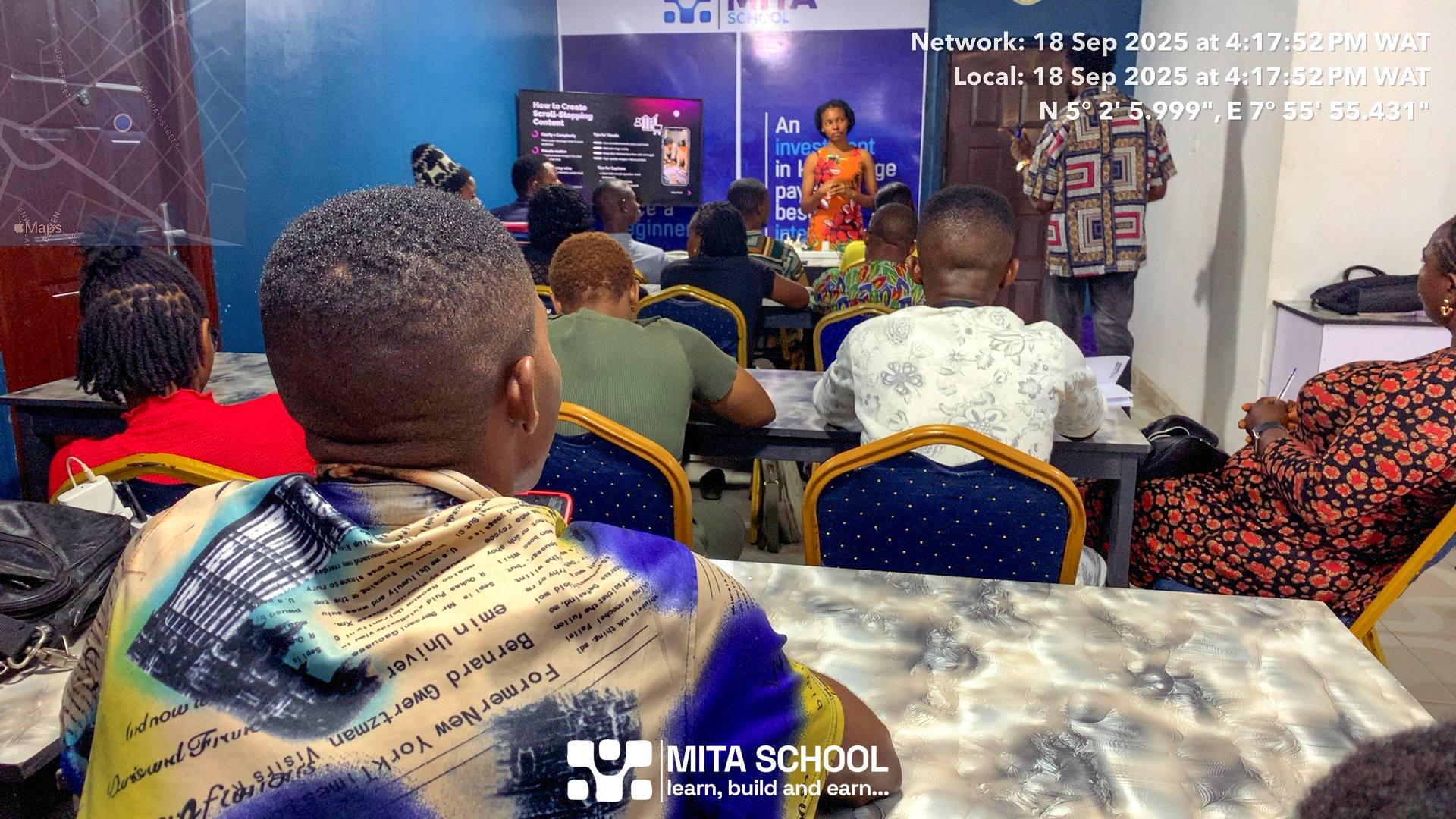
This is where institutions such as Mita School can contribute to the broader conversation around youth empowerment.
The objective should not simply be to teach young people a technology skill.
It should be to help them move from learning to application.
Mita School’s training approach focuses on practical digital skills across areas including:
- Web Development
- Data Analysis
- UI/UX Design
- Cybersecurity
- Digital Marketing
- Other technology-focused programmes
The importance of this approach is the connection between what students learn and what they can eventually demonstrate.
For example, a student learning web development should not stop at understanding HTML, CSS, JavaScript, and React.
They should build websites.
A data analysis student should not simply learn Excel, Power BI, SQL, Python, or Tableau.
They should work with datasets and produce analysis.
A digital marketing student should not only learn marketing concepts.
They should understand how those concepts are applied to real campaigns and businesses.
That practical orientation is essential to meaningful skill development in Akwa Ibom.
The Future of Youth Empowerment in Akwa Ibom
The future of youth empowerment cannot depend entirely on creating more programmes.
It must also depend on creating better outcomes.
The question should no longer be:
How many young people attended the programme?
It should be:
How many young people can now do something they could not do before?
How many built businesses?
How many secured employment?
How many started freelancing?
How many created portfolios?
How many became financially independent?
How many went on to create opportunities for others?
Those are stronger indicators of meaningful empowerment.
For Akwa Ibom, the opportunity is significant.
The state has young people with ambition, creativity, education, and potential.
What is needed is a stronger bridge between that potential and the opportunities available in the modern economy.
Skill development can be that bridge.
Final Thoughts: Skills Must Become the Foundation of Empowerment
The problem facing young people in Nigeria is not simply that they lack opportunities.
In many cases, there is a deeper problem:
The gap between potential and the ability to convert that potential into economic value.
A university degree can provide knowledge.
An empowerment programme can provide resources.
A grant can provide capital.
But practical skills give people the ability to use opportunities effectively and create value repeatedly.
That is why skill development in Akwa Ibom deserves a much bigger place in the conversation around youth empowerment.
The goal should not be to replace education with skills.
It should be to connect education with skills.
It should not be to replace government empowerment programmes.
It should be to make those programmes more sustainable.
And it should not be to tell every young person to become a technology professional.
It should be to help every young person discover a valuable skill they can develop, apply, and potentially turn into economic opportunity.
Because real empowerment is not simply giving someone something.
Real empowerment is increasing their ability to do something for themselves.
That is why the missing link in Nigeria’s youth empowerment system may not be another programme.
It may be better, more practical, more accessible, and more sustainable skill development.
And for Akwa Ibom’s young people, that could make the difference between simply preparing for an opportunity and actually being prepared when it arrives.
Build the skills that create opportunities
If you are in Akwa Ibom and ready to develop practical digital skills, Mita School provides structured training designed to help learners move from foundational knowledge to practical application.
Explore Mita School’s programmes
Learn Web Development · Learn Data Analysis · Learn Digital Marketing