
Where to Learn Web Development in Uyo: The Best Guide for Beginners in 2026
Table of Contents
- Quick Answer: Where to Learn Web Development in Uyo
- Introduction
- What Is Web Development?
- Why Learn Web Development in Uyo?
- What to Look for When Choosing a Web Development School
- What You Will Learn in a Web Development Course
- Front-End Web Development Training at Mita School
- Back-End Web Development Training at Mita School
- Web Development Tools and Technologies You Will Learn
- Practical Projects and Portfolio Development
- Who Can Learn Web Development at Mita School?
- Career Opportunities After Learning Web Development
- How Long Does It Take to Learn Web Development?
- How to Start Learning Web Development in Uyo
- Frequently Asked Questions
Quick Answer: If you are looking for where to learn web development in Uyo, Mita School offers a practical, project-based Front-End Web Development programme designed for beginners and aspiring developers. The four-month programme covers HTML, CSS, Bootstrap, JavaScript, React, Git and GitHub, APIs, responsive web design, accessibility, SEO basics, deployment, and real-world projects.
Mita School also offers Back-End Web Development with PHP and Laravel, giving learners a pathway from building website interfaces to developing complete web applications. Students work on practical projects, build a portfolio, complete a final capstone project, and receive a certificate of completion.
If your goal is to learn web development in Uyo and develop practical skills you can use for employment, freelancing, or further technical training, Mita School is one of the options worth considering.
Understanding What Web Development Really Is
If you have been searching for where to learn web development in Uyo, it is important to first understand what web development actually involves and what you will be learning.
Web development is the process of building, maintaining, and improving websites and web applications. It involves everything from creating the structure and appearance of a website to developing the systems that allow users to interact with it.
Think about the websites and applications you use every day. An online store, banking platform, school portal, booking website, news website, or business website all require web developers to build and maintain them.
Web development generally falls into three areas:
Front-End Development
Front-end development focuses on everything users see and interact with on a website.
This includes:
- Website layouts
- Navigation menus
- Buttons
- Forms
- Images
- Animations
- Responsive designs
- Interactive features
Front-end developers commonly work with technologies such as HTML, CSS, JavaScript, Bootstrap, and React.
Back-End Development
Back-end development focuses on what happens behind the scenes.
It involves:
- Server-side programming
- Databases
- User authentication
- Application logic
- APIs
- Data processing
- Security
For example, when you log into an online platform, the front end provides the login form, while the back end processes your information and determines whether you should be granted access.
Full-Stack Development
Full-stack development combines both front-end and back-end development.
A full-stack developer can work across the entire development process, from creating the user interface to building the database and server-side functionality.
This is one reason web development remains a valuable technical skill. A learner can begin with front-end development and gradually expand into back-end and full-stack development.
If you are searching for where to learn web development in Uyo because you are completely new to technology, you do not necessarily need to begin by trying to master everything at once. A structured programme can take you from the fundamentals and gradually introduce more advanced technologies.
Why Web Development Is Still Worth Learning in 2026
One of the biggest questions people ask when searching for where to learn web development in Uyo is whether web development is still worth learning in 2026.
The answer is yes, particularly for people who want a practical technical skill that can be applied to employment, freelancing, business, and digital product development.
Businesses need websites. Startups need web applications. Schools need portals. E-commerce companies need online stores. Organisations need platforms that allow customers to interact with their services.
This creates opportunities for people who can build and maintain these digital products.
Web development can also give you flexibility in how you build your career.
You can pursue opportunities as a:
- Front-end developer
- Back-end developer
- Full-stack developer
- Freelance web developer
- WordPress developer
- PHP developer
- React developer
- Junior software developer
You can also use the skill to build your own projects instead of depending entirely on an employer.
For example, an entrepreneur who understands web development can build a basic version of a business idea, work with other developers more effectively, or understand what is technically possible before investing heavily in a product.
The opportunity is not limited to Uyo either.
Once you develop strong technical skills and a portfolio, your potential market extends beyond Akwa Ibom State. Web development is inherently digital, meaning your work can be presented to employers and clients outside your immediate location.
This is one of the reasons people looking for where to learn web development in Uyo should look beyond simply finding a classroom. The quality of the curriculum, practical projects, mentorship, portfolio development, and career preparation all matter.
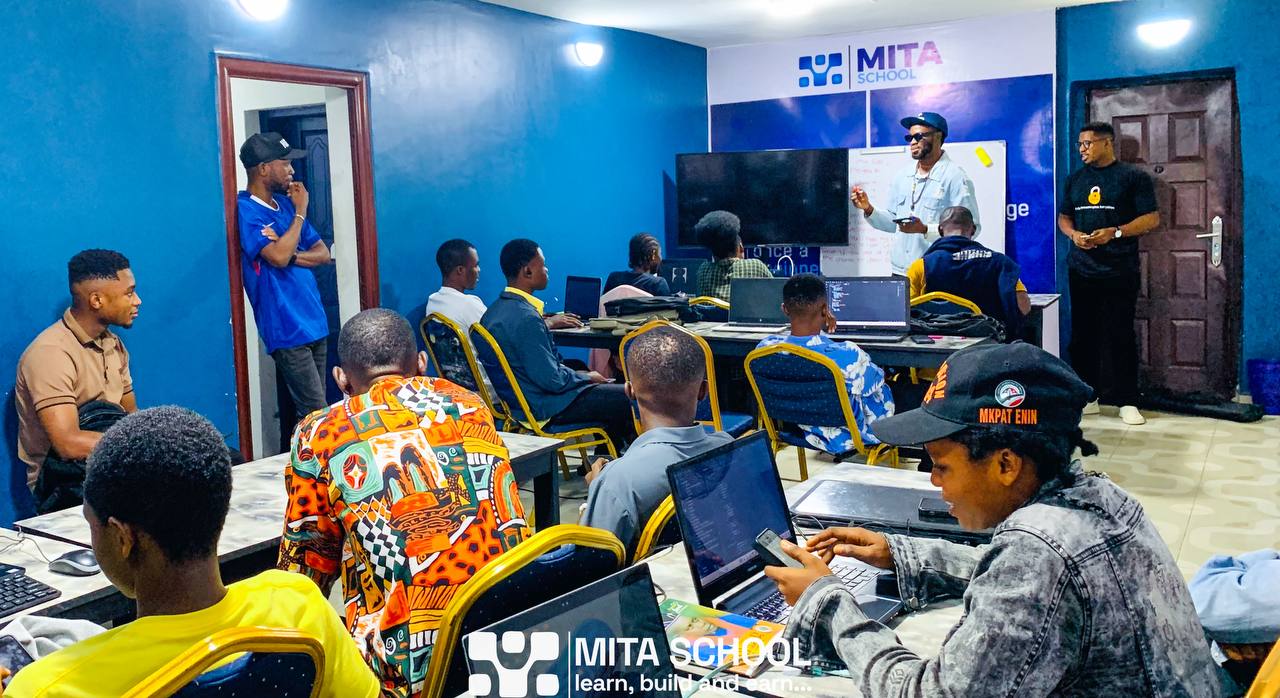
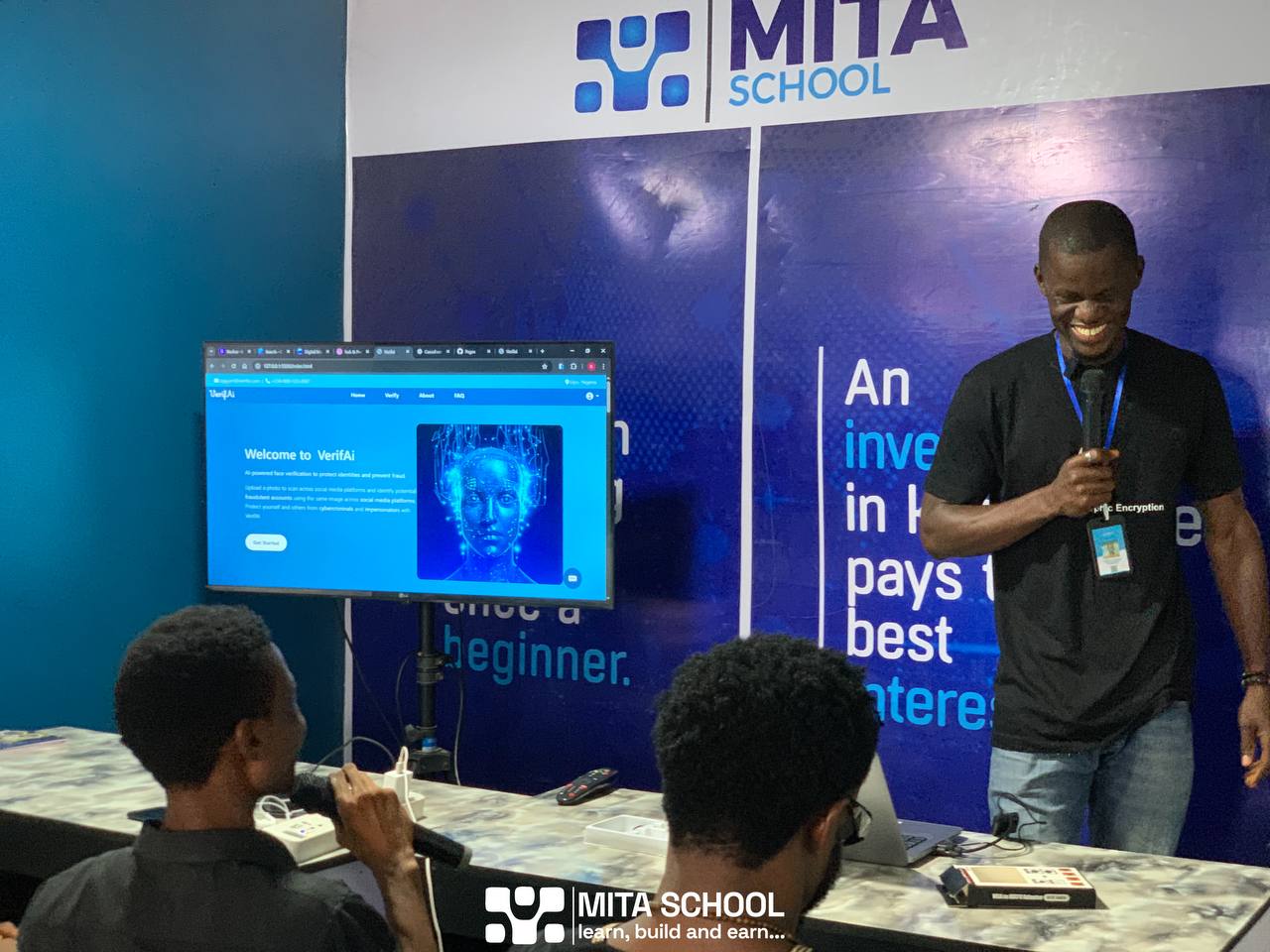
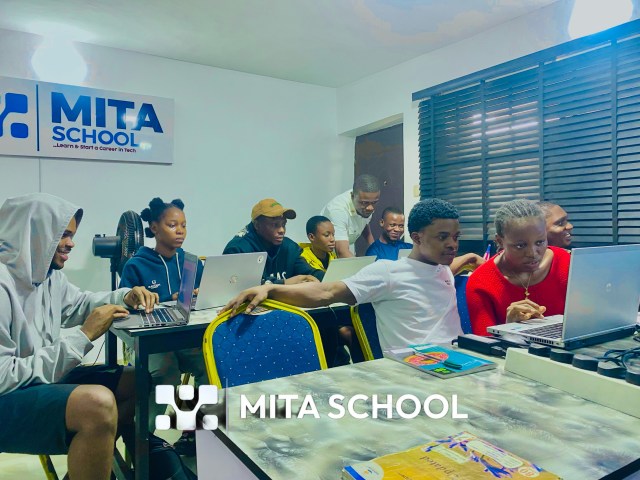
Mita School positions its training around practical digital skills, with physical classes in Uyo, beginner-friendly programmes, real projects, mentorship, and career-focused learning. Mita School
Front-End vs Back-End Development
If you are researching where to learn web development in Uyo, you will eventually encounter two terms repeatedly: front-end development and back-end development.
Understanding the difference can help you decide where to begin.
What Is Front-End Development?
Front-end development is concerned with the part of a website that users interact with directly.
For example, when you visit a website and click a button, fill out a form, open a menu, or navigate between pages, you are interacting with the front end.
A strong front-end developer needs to understand:
- HTML
- CSS
- Responsive design
- JavaScript
- DOM manipulation
- APIs
- Git and GitHub
- Modern frameworks such as React
Mita School’s front-end curriculum progresses from HTML and CSS fundamentals to Bootstrap, JavaScript, APIs, modern JavaScript, React, accessibility, performance, SEO basics, and deployment. The programme also includes practical projects throughout the 16-week structure.
What Is Back-End Development?
Back-end development handles the systems that power a website or application behind the interface.
A back-end developer may work with:
- PHP
- MySQL
- Laravel
- Databases
- Authentication
- APIs
- Server-side logic
- Security
- Deployment
Mita School’s back-end programme follows a progression from PHP fundamentals and databases to MySQL, authentication, CRUD applications, Laravel, MVC architecture, APIs, security, and deployment.
Which One Should You Learn First?
There is no universal answer.
If you enjoy designing interfaces and seeing the immediate visual results of your code, front-end development may be a good starting point.
If you are more interested in databases, application logic, authentication, and how systems work behind the scenes, back-end development may appeal to you.
However, learning both eventually gives you a broader understanding of how modern web applications are built.
This is why someone searching for where to learn web development in Uyo should consider a programme that provides a clear progression rather than simply teaching isolated programming languages.
What You Should Look for in a Web Development Course
Finding where to learn web development in Uyo is easy.
Finding a programme that actually prepares you to build useful projects is the more important question.
Before choosing a web development course in Uyo, consider these factors.
1. Does the Programme Start From the Fundamentals?
Beginners should not be expected to understand advanced programming concepts immediately.
A good programme should explain the foundations before moving into frameworks and advanced development.
2. Does It Include Practical Projects?
Watching someone code is not the same as building something yourself.
A practical web development training programme should give you opportunities to apply what you learn.
Mita School’s curriculum includes projects throughout the training, including personal webpages, business landing pages, responsive websites, interactive applications, API-based projects, React applications, PHP systems, and Laravel applications.
3. Does It Teach Modern Development Tools?
The industry changes quickly.
A programme should expose learners to tools that are relevant to actual development workflows, including:
- VS Code
- Git
- GitHub
- Bootstrap
- JavaScript
- React
- PHP
- MySQL
- Laravel
- APIs
- Deployment platforms
4. Does It Help You Build a Portfolio?
A certificate alone does not demonstrate what you can build.
A portfolio allows potential employers and clients to see your actual work.
5. Is There Guidance Beyond the Classroom?
Learning to code is only part of becoming a developer.
Beginners also need guidance around:
- Portfolio development
- GitHub optimisation
- Freelancing
- Job applications
- Project presentation
- Career direction
Mita School’s current web-development programme specifically includes portfolio development, GitHub profile optimisation, freelancing, and job-readiness preparation. Mita School
What You Will Learn at Mita School
If you are searching for where to learn web development in Uyo and want a programme that moves from beginner fundamentals into practical development, Mita School’s curriculum is structured across both front-end and back-end development.
Front-End Web Development
The front-end programme runs for four months, covering 16 weeks.
The first month focuses on HTML and CSS foundations.
Students learn:
- How the web works
- HTML structure
- HTML elements and attributes
- Semantic HTML
- CSS
- The CSS box model
- Flexbox
- CSS Grid
- Responsive design
- Media queries
- Mobile-first design
The second month introduces Bootstrap 5 and modern UI development, including responsive layouts, components, forms, navigation, custom styling, and complete website projects.
The third month focuses on JavaScript and the DOM. Students move from JavaScript fundamentals into events, DOM manipulation, forms, arrays, objects, JSON, and API integration.
The fourth month introduces modern JavaScript and React, followed by performance optimisation, accessibility, SEO basics, cross-browser testing, deployment, portfolio development, and career preparation.
Back-End Web Development
The back-end programme adds another layer to the learning journey.
Students begin with PHP, learning programming fundamentals, control structures, functions, arrays, forms, validation, authentication, sessions, and security.
The programme then introduces MySQL, including databases, relationships, SQL queries, CRUD operations, pagination, search, and admin dashboard logic.
The final stage moves into Laravel, covering MVC architecture, routing, controllers, Blade templates, Eloquent ORM, authentication, middleware, APIs, authorisation, security, and deployment.
This progression means learners are not simply memorising programming syntax. They are learning how different technologies work together to create functional web applications.
Mita School’s existing web-development offering similarly describes its approach as practical and project-based, with front-end and back-end components and training designed for beginners. (Mita School)
The Projects You Should Build While Learning
One of the most important things to consider when deciding where to learn web development in Uyo is what you will actually build during the programme.
Projects turn theoretical knowledge into demonstrable skills.
At Mita School, the curriculum is designed around projects that become progressively more complex.
Personal Webpage
This introduces beginners to the basic structure of a website and gives them their first opportunity to publish content using HTML and CSS.
Multi-Page Static Website
Students move beyond a single page and learn how different pages can work together as a complete website.
Business Landing Page
This introduces practical website structure and design, allowing students to build something that resembles a real business website.
Responsive Company Website
Students learn how websites adapt to different screen sizes using responsive design principles, Flexbox, Grid, and media queries.
Interactive To-Do Application
JavaScript becomes practical here. Students can create an application that responds to user actions and manipulates information dynamically.
Weather or API-Based Application
Students learn how applications can retrieve information from external APIs and display that information to users.
React Portfolio Website
This brings together modern JavaScript and React concepts while producing a project that can become part of the learner’s professional portfolio.
PHP and Laravel Projects
Back-end students progress into practical systems such as authentication applications, CRUD systems, role-based applications, API-powered platforms, and larger projects such as school management, e-commerce, booking, or logistics systems.
The purpose is simple: you should leave training with something you can show, not just something you can say you learned.
That distinction matters when applying for jobs, pitching clients, or pursuing freelance opportunities.
Can a Complete Beginner Become a Web Developer?
If you have been searching for where to learn web development in Uyo but keep thinking, “I don’t have a tech background,” that should not automatically stop you.
Web development can be learned progressively.
You do not need to understand React before learning HTML. You do not need to understand Laravel before learning PHP. And you do not need to understand databases before learning how websites work.
The important thing is having a structured learning path.
A beginner can start with:
HTML → CSS → Responsive Design → Bootstrap → JavaScript → DOM → APIs → Modern JavaScript → React
and then progress into:
PHP → MySQL → Authentication → CRUD → Laravel → APIs → Deployment.
This gradual progression is particularly important for beginners because trying to learn everything simultaneously can quickly become overwhelming.
Mita School’s programmes are designed for beginners, and its broader training model emphasises starting from the fundamentals and building practical understanding through guided learning and hands-on practice. (Mita School)
You also do not need to become an expert before building your first project.
In fact, projects should be part of the learning process.
Build something small.
Make mistakes.
Find out why the code does not work.
Fix it.
Build something slightly more complex.
Repeat.
That is how theoretical knowledge becomes practical ability.
So, if you are currently asking where to learn web development in Uyo, do not only ask, “Which school teaches coding?”
Ask:
Will this programme take me from where I am now to being able to build something real?
That is the question that should guide your decision.
How Long Does It Take to Learn Web Development?
If you are searching for where to learn web development in Uyo, one of the first questions you may have is: how long does it take to become a web developer?
There is no single answer because web development is a broad field, and the time required depends on what you want to learn and how consistently you practise.
However, having a structured curriculum can make the process much clearer.
At Mita School, the Front-End Web Development Programme runs for four months, or 16 weeks, with three to four sessions each week. The programme is designed to take learners from the fundamentals of web development through modern front-end technologies and real-world projects.
The progression looks like this:
Month 1: HTML and CSS Foundations
Students begin by understanding how the web works before moving into HTML, CSS, page structure, layouts, and responsive design.
Projects include:
- A personal webpage
- A multi-page static website
- A styled business landing page
- A responsive company website
Month 2: Bootstrap and Modern UI Development
Students learn Bootstrap 5 and how to use its grid system, components, utilities, forms, navigation, and responsive features.
The focus is not simply on memorising Bootstrap classes. Students use the framework to build complete website layouts and responsive projects.
Month 3: JavaScript and the DOM
This is where websites become more interactive.
Students learn:
- JavaScript fundamentals
- Variables and data types
- Functions
- Events
- DOM manipulation
- Forms
- Arrays and objects
- JSON
- Fetch API
- External APIs
Projects include an interactive to-do application and an API-based project such as a weather application.
Month 4: React and Deployment
Students progress into modern JavaScript and React.
They learn:
- ES6+ features
- Arrow functions
- Destructuring
- Modules
- Local storage
- React components
- JSX
- Props
- State
- Event handling
- Conditional rendering
- Routing
The programme then moves into performance, accessibility, SEO basics, cross-browser testing, deployment, portfolio development, and career preparation.
The back-end programme adds another eight weeks covering PHP, MySQL, Laravel, APIs, authentication, deployment, and real-world projects.
This means a learner who wants to develop broader full-stack capabilities can progress from front-end development into back-end development through a structured pathway.
The key point is that learning web development is not about how quickly you can finish a course. It is about how much you can build and understand by the time you finish.
Career Opportunities After Training
Another important reason people search for where to learn web development in Uyo is the career opportunity that comes with developing practical programming skills.
Web development can lead to different career paths depending on the technologies and specialisations you develop.
Front-End Developer
Front-end developers build the interfaces users interact with.
They commonly work with:
- HTML
- CSS
- JavaScript
- Bootstrap
- React
A front-end developer may work on business websites, e-commerce platforms, dashboards, web applications, and other digital products.
Back-End Developer
Back-end developers build the systems that operate behind the interface.
They may work with:
- PHP
- MySQL
- Laravel
- APIs
- Authentication systems
- Databases
Full-Stack Developer
A full-stack developer works across both front-end and back-end development.
This allows them to understand how the interface, application logic, databases, and server-side systems connect.
PHP Developer
PHP remains useful for building dynamic websites and web applications.
Mita School’s back-end programme introduces students to PHP fundamentals before progressing into databases and Laravel.
Laravel Developer
Laravel is a PHP framework used to build structured web applications.
Students who progress through the Laravel component of the programme learn concepts including:
- MVC architecture
- Routing
- Controllers
- Blade templates
- Eloquent ORM
- Authentication
- Middleware
- APIs
- Authorisation
- Security
- Deployment
Freelance Web Developer
Web development can also be used as a freelance service.
Instead of working for a single company, developers can build websites and web applications for different clients.
Potential clients include:
- Small businesses
- Startups
- Schools
- Churches
- NGOs
- E-commerce businesses
- Professional service providers
Remote Developer
Web development is also compatible with remote work.
Because the work is performed digitally, developers can collaborate with organisations outside their immediate location.
This is particularly valuable for someone learning web development in Uyo because your physical location does not necessarily have to limit the market you serve.
However, remote opportunities are competitive. Technical knowledge alone is not enough. You also need a strong portfolio, communication skills, problem-solving ability, and evidence that you can complete projects.
Can You Freelance or Work Remotely After Training?
If you are looking for where to learn web development in Uyo because you want to become a freelancer or work remotely, it is important to understand what clients and employers actually look for.
Completing a course is only the beginning.
The next step is demonstrating that you can solve problems.
Imagine two developers applying for the same opportunity.
Developer A says:
“I completed a four-month web development course.”
Developer B says:
“I built and deployed a responsive business website, an interactive JavaScript application, an API-powered weather application, and a React portfolio website. Here is my GitHub profile and here are the live projects.”
The second developer has given the employer something concrete to evaluate.
This is why practical projects are such an important part of Mita School’s curriculum.
Freelance Services You Can Offer
Depending on your skill level, you can eventually offer services such as:
- Business website development
- Landing page development
- Responsive website development
- Website redesign
- Front-end development
- React development
- PHP development
- Laravel development
- API integration
- Website maintenance
You can also specialise in particular industries or types of projects.
For example, you might focus on building websites for:
- Real estate companies
- Schools
- Restaurants
- E-commerce businesses
- Churches
- Professional services
- Startups
Remote Work
Remote development roles may include:
- Junior Front-End Developer
- React Developer
- PHP Developer
- Back-End Developer
- Web Developer
- Junior Full-Stack Developer
However, it is important not to treat remote work as an automatic outcome of completing training.
You still need to develop your skills, build projects, improve your GitHub profile, create a professional portfolio, and learn how to communicate with clients or employers.
That is why career preparation forms part of the Mita School curriculum rather than being treated as something completely separate from technical training.
How to Build a Web Developer Portfolio
When comparing where to learn web development in Uyo, one of the most important questions to ask is whether the programme helps you build a portfolio.
A portfolio is a collection of projects that demonstrates what you can actually do.
For a beginner, this can be more useful than simply listing programming languages on a CV.
Instead of saying:
HTML, CSS, JavaScript, React, PHP and Laravel
your portfolio should demonstrate those skills through actual projects.
What Should Your Portfolio Include?
A beginner front-end developer could include:
1. Personal Website
This demonstrates your ability to structure and style a website.
2. Business Landing Page
This demonstrates layout, design, responsiveness, and user experience.
3. Responsive Website
This shows that you understand how websites behave across different screen sizes.
4. JavaScript Application
A to-do application can demonstrate DOM manipulation, events, and JavaScript logic.
5. API-Based Application
A weather application can demonstrate your ability to work with external APIs and dynamically display information.
6. React Application
A React portfolio or application demonstrates your understanding of components, props, state, routing, and modern JavaScript.
Back-end developers can add projects such as:
- Authentication systems
- CRUD applications
- User management systems
- Database-driven applications
- Laravel applications
- API-powered applications
Mita School’s curriculum deliberately incorporates these types of projects, including a personal webpage, multi-page websites, business landing pages, interactive applications, API-based projects, React applications, PHP CRUD applications, authentication systems, and Laravel-based final projects.
Your GitHub Profile Also Matters
GitHub allows developers to store and showcase their code.
A good GitHub profile can demonstrate:
- Projects you have built
- Code organisation
- Commit history
- Documentation
- Collaboration
- Consistency
This is why Git and GitHub are introduced during the Mita School front-end programme.
If you are researching where to learn web development in Uyo, don’t just ask whether the school teaches programming languages. Ask whether you will graduate with evidence of what you can build.
How to Choose the Right Training Programme
There are different ways to learn web development.
You can learn independently through online resources, follow YouTube tutorials, enrol in an online programme, or attend a physical web development training programme in Uyo.
Each approach has advantages.
However, beginners often struggle with self-learning because there is simply too much information available.
You may find one tutorial teaching HTML, another teaching React, another recommending a completely different technology, and another telling you to learn something else first.
Without a structured roadmap, it can become difficult to know what to learn, what to ignore, and what to practise.
If you are deciding where to learn web development in Uyo, consider the following.
Look at the Curriculum
A good programme should show you exactly what you will learn.
Mita School’s curriculum progresses from fundamentals into practical development rather than immediately placing beginners into advanced frameworks.
Look for Practical Training
Coding is a practical skill.
You should spend time writing code, debugging errors, building applications, and working with development tools.
Check the Projects
Find out what students actually build.
Projects should increase in complexity as the training progresses.
Consider the Duration
Avoid programmes that promise to make you an expert in an unrealistically short period.
Web development requires practice.
Mita School’s front-end programme runs for four months, while its back-end programme runs for two months.
Look Beyond Certification
A certificate can demonstrate that you completed training.
However, a portfolio demonstrates what you can build.
The strongest programmes should help you develop both.
Consider Career Support
Look for training that goes beyond technical lessons and provides guidance around:
- Portfolio development
- GitHub
- Freelancing
- Job readiness
- Project presentation
- Career direction
Ultimately, the best web development school in Uyo for you is the one whose learning structure matches your goals, learning style, current skill level, and desired career path.
Why Choose Mita School?
If you are specifically searching for where to learn web development in Uyo, Mita School provides a structured environment for learning practical technology skills.
The goal is not simply to introduce students to programming concepts.
The web development curriculum is designed to move learners through a progression:
Fundamentals → Practice → Projects → Modern Technologies → Deployment → Portfolio → Career Preparation
For front-end development, students progress from HTML and CSS to Bootstrap, JavaScript, APIs, React, accessibility, performance, and deployment.
For back-end development, students progress from PHP and programming fundamentals into MySQL, authentication, CRUD operations, Laravel, APIs, security, and deployment.
Practical Learning
Students work on projects throughout the programme rather than waiting until the end of training before applying what they have learned.
Beginner-Friendly Structure
The curriculum starts with fundamentals and progressively introduces more advanced concepts.
This makes the programme suitable for people who are beginning their web development journey.
Modern Tools
Students are exposed to tools and technologies used across contemporary web development workflows, including:
- HTML5
- CSS3
- Bootstrap 5
- JavaScript
- React
- PHP
- MySQL
- Laravel
- Git
- GitHub
- APIs
Portfolio Development
Students don’t just learn concepts. They work on projects that can contribute to a professional portfolio.
Career Preparation
The curriculum also includes GitHub optimisation, portfolio development, freelancing, and job-readiness preparation.
For someone looking for where to learn web development in Uyo, this combination of technical training, practical projects, and career preparation can provide a more complete learning experience than simply watching disconnected tutorials online.
Frequently Asked Questions About Where to Learn Web Development in Uyo
1. Where can I learn web development in Uyo?
If you are looking for where to learn web development in Uyo, Mita School offers structured front-end and back-end web development training. The programmes cover technologies including HTML, CSS, Bootstrap, JavaScript, React, PHP, MySQL, Laravel, Git, GitHub, APIs, and deployment.
2. How long does it take to learn web development at Mita School?
The Front-End Web Development Programme runs for four months, or 16 weeks.
The Back-End Web Development Programme using PHP and Laravel runs for two months, or eight weeks.
Students work on practical projects throughout the programmes.
3. Can a beginner learn web development?
Yes. The curriculum starts with fundamental concepts before progressing into more advanced technologies.
You do not need to already be an experienced programmer to begin learning web development.
4. What programming languages will I learn?
The curriculum includes HTML, CSS, JavaScript, PHP, SQL, and modern JavaScript through React. Students also learn frameworks, libraries, databases, APIs, version control, and deployment.
5. Will I build real projects?
Yes. Projects include personal websites, business landing pages, responsive websites, JavaScript applications, API-based applications, React projects, PHP CRUD systems, authentication systems, and Laravel applications.
6. Can web development help me get a remote job?
Web development can provide access to remote employment and freelance opportunities. However, completing training does not automatically guarantee a remote job. You need practical skills, a portfolio, strong communication, and the ability to demonstrate that you can solve real problems.
7. Do I need a Computer Science degree to become a web developer?
No. A Computer Science degree can be useful, but web development is also a practical skill that can be learned through structured training, self-study, projects, and professional experience.
Your ability to demonstrate what you can build is particularly important when applying for development opportunities.
8. Is web development still worth learning in 2026?
Yes. Websites and web applications remain important to businesses, organisations, startups, and digital platforms. Learning web development can create opportunities in employment, freelancing, remote work, and entrepreneurship.
9. Should I learn front-end or back-end development first?
For many beginners, front-end development provides a useful starting point because you can immediately see the results of your code in a browser. However, the best choice depends on your interests and career goals.
You can also progress from front-end development into back-end development and eventually develop full-stack capabilities.
10. What should I look for when choosing a web development course in Uyo?
Look for a programme with:
- A structured curriculum
- Experienced instructors
- Practical projects
- Modern development tools
- Portfolio development
- Git and GitHub training
- Career preparation
- Adequate time for practice
Most importantly, choose a programme that teaches you how to build, not simply how to follow tutorials.
Final Thoughts
Searching for where to learn web development in Uyo is only the beginning.
The more important question is what happens after you enrol.
Will you understand how websites work?
Will you be able to write code independently?
Will you build real projects?
Will you have a portfolio?
Will you understand how to deploy your work?
Will you be prepared to pursue jobs, freelancing, or remote opportunities?
A strong web development programme should help answer all of these questions.
At Mita School, the learning path moves from HTML and CSS foundations to JavaScript, React, PHP, MySQL, Laravel, APIs, deployment, portfolio development, and career preparation.
If you are ready to learn a practical technology skill and start building websites and web applications, Mita School provides a structured place to begin your web development journey in Uyo.